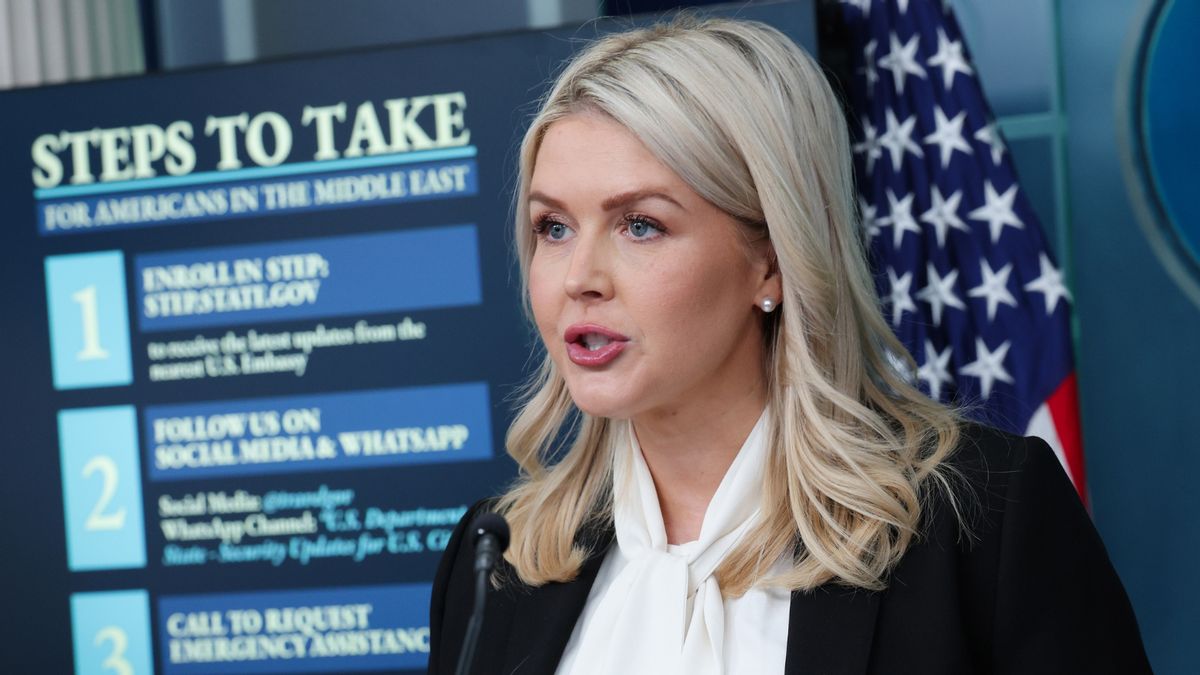
Karoline Leavitt on Military Draft: Deciphering Her 'Options'
The political landscape is often a minefield of carefully chosen words, and few phrases ignite public discourse quite like "military draft." Recent comments by White House press secretary Karoline Leavitt have thrown this sensitive topic back into the spotlight, sparking widespread debate and concern. During a Fox News appearance, Leavitt's nuanced responses regarding the possibility of conscription, particularly in the context of escalating tensions with Iran, led many to question the administration's stance. While she explicitly stated that a draft was "not part of the current plan right now," her subsequent insistence that President Trump "wisely keeps his options on the table" created a flurry of interpretations, igniting alarms and fueling viral claims across social media. This article delves into the specifics of Leavitt's statements, the strategic implications of her language, and the broader reality of a U.S. military draft.
The Genesis of the 'Options' Controversy
The focal point of the recent discussion around a potential military draft emerged from a Sunday, March 8 interview on Fox News. Anchor Maria Bartiromo directly asked Karoline Leavitt whether Americans could be "forced to fight," expressing concern from "moms worried we're gonna have a draft." Leavitt's response, while seemingly straightforward at first, carried a crucial distinction that quickly became the subject of intense scrutiny.
Leavitt unequivocally stated that ground troops were "not part of the plan" at present and reiterated, "It's not part of the current plan right now." However, she immediately followed this by emphasizing that President Trump, as commander-in-chief, "wisely does not remove options off of the table." She elaborated, saying, "I know a lot of politicians like to do that quickly, but the president... wants to continue to assess the success of this military operation." This careful choice of words – a current denial coupled with a refusal to categorically rule out future possibilities – was instantly seized upon by reporters, political opponents, and progressive groups. Critics framed her phrasing as a startling admission that a draft could be initiated, leading to a wave of activist posts and opinion pieces describing the comment as proof that conscription might be on the horizon. Despite the media storm, it's important to note that no internal White House document, Pentagon statement, or other primary evidence has surfaced to suggest a draft is formally being considered or that conscription processes have been activated. The White House's Rapid Response team later issued a denial on X, stating, "She didn't say anything close to this. You just made it up," directly refuting widespread claims of an announced draft.
Deconstructing Leavitt's Language: A Strategic Posture?
Understanding Karoline Leavitt's comments requires a deeper look into the nature of political communication and strategic positioning, especially from a White House press secretary. The phrase "keeping his options on the table" is a staple in the lexicon of foreign policy and military strategy. It signifies a desire to maintain flexibility, to avoid cornering oneself, and to project a stance of readiness for any eventuality. For a Commander-in-Chief like President Trump, particularly amidst the escalating conflict with Iran that involved air assaults and cooperation with Israel, such a statement can be interpreted as a deliberate strategy to retain maximum leverage and adaptability.
When Leavitt stated, "President Trump wisely does not remove options off of the table," she was arguably communicating a strategic posture rather than a specific policy intention regarding a
Trump's Military Draft Stance: Not Part of Current Plan, Options Open. In a volatile geopolitical environment, prematurely ruling out any option, even one as drastic as a draft, could be seen as telegraphing limitations or weaknesses to adversaries. The administration's focus, as Leavitt explained, was on "protecting the American people and our troops and bases in the Middle East," and maintaining all options can be framed as part of that overarching responsibility. This distinction between "not part of the current plan" and "not being considered at all" is crucial. While the former indicates no immediate intent, the latter would be a definitive commitment that a president might hesitate to make if future circumstances are unpredictable. Therefore, Leavitt's careful choice of words may have been intended to convey strength and preparedness, even if it inadvertently generated public anxiety.
The Reality of a U.S. Military Draft: Historical Context and Current Status
The idea of a military draft evokes strong memories of past conflicts, particularly the Vietnam War, which saw the last compulsory conscription in the United States. Since then, the U.S. military has operated as an all-volunteer force, a model that has largely proven effective in meeting its personnel needs. However, the legal framework for a draft still exists through the Selective Service System.
Understanding the Selective Service System
*
Registration Requirement: By law, almost all male U.S. citizens and male immigrants residing in the U.S. must register with the Selective Service System within 30 days of their 18th birthday. This registration continues until their 26th birthday.
*
Purpose: The Selective Service System maintains a database of potential draftees. While there is no active draft, this system ensures that if a national emergency or crisis were to necessitate a rapid increase in military personnel beyond the capacity of volunteers, a fair and equitable system for conscription could be activated.
How a Draft Would Be Reinstated
Reinstating a military draft in the U.S. is not a simple executive order. It would require a series of significant steps, including:
- Congressional Action: Both the House of Representatives and the Senate would need to pass legislation authorizing a draft.
- Presidential Approval: The President would then have to sign this legislation into law.
- Selective Service Activation: Only after this legislative process would the Selective Service System be activated to begin the process of calling individuals for service. This process involves a lottery system based on birth dates, followed by physical, mental, and moral evaluations.
Given the current success of the all-volunteer force and the political sensitivity surrounding conscription, the threshold for reactivating a draft is incredibly high. It would likely only occur in a scenario of widespread national emergency or existential threat that severely overwhelms current military recruitment capabilities. Karoline Leavitt's comments do not indicate any such legislative or preparatory steps are underway.
Navigating the Viral Claims and Political Fallout
Karoline Leavitt's noncommittal language quickly spiraled into a media firestorm, largely amplified by the nature of modern news dissemination and social media. Critics and progressive groups were quick to interpret her "options on the table" remark as a startling admission, transforming a nuanced statement into viral claims about an impending draft. This rapid dissemination of information, often stripped of its original context, highlights a significant challenge in public discourse.
The initial reports consistently reproduced Leavitt’s careful phrasing, yet the subsequent political fallout saw the comments being repackaged as definitive proof that a draft was imminent. This amplification of concern, despite the explicit denial of a "current plan," demonstrates how political opponents can leverage ambiguous language to rally support or sow doubt. The swift reaction from the White House's Rapid Response team to counter these narratives underscores the sensitivity of the topic and the potential for misinterpretation. For a more detailed look into how these claims went viral and the reality behind them, see our related article:
Leavitt's Draft Comments: Unpacking the Viral Claims & Reality. It’s a testament to the power of rhetoric that a statement intended to convey strategic flexibility could be so widely perceived as a harbinger of conscription.
Conclusion
The discussion surrounding Karoline Leavitt's comments on a military draft serves as a prime example of the complexities inherent in political communication. While the White House press secretary clearly stated that a draft is "not part of the current plan right now," her subsequent emphasis on President Trump "wisely keep[ing] his options on the table" opened the door for wide-ranging interpretations. This strategic ambiguity, common in high-stakes foreign policy discussions, was quickly amplified by critics and social media, leading to widespread concern about the possibility of conscription. However, based on available reporting, there is no evidence to suggest that a military draft is being formally considered or planned by the U.S. government. The United States continues to operate under an all-volunteer military system, and reactivating a draft would require significant legislative action, a far cry from a press secretary's rhetorical maneuvering. Ultimately, Leavitt's remarks were a demonstration of maintaining strategic flexibility as Commander-in-Chief, rather than an announcement of imminent policy change.